



Latest News

FIRST FLIGHT OF ROYAL NETHERLANDS NAVY NH90 NFH
10 August 2007

NHIndustries on behalf of AgustaWestland, a Finmeccanica Company, announces that the first
serial production NH90 for the Royal Netherlands Navy performed the maiden flight on Friday 10th
August at AgustaWestland’s Vergiate facility in Italy.
The helicopter (NNLN001) took off at 14.45 h and the flight duration was of about 20 minutes. In
flight preliminary checks fulfilled all expectations.
Operational Representatives of the Dutch Customer joined the event.
In the frame of the NH90 Programme work-share, AgustaWestland is responsible of the overall
integration of the NH90 naval mission system for all NH90 naval variants (NFH: NATO Frigate
Helicopter).
The NH90 NFH variant is primarily designed for autonomous Anti-Submarine Warfare (ASW) and
Anti Surface Warfare (ASuW) missions. The intrinsic characteristics and comprehensive mission
equipment packages allow an unequalled range of additional operations: Search and Rescue
(SAR), maritime patrol, vertical replenishment, troop transport, medical services and “Utility” roles.
The helicopter is designed for day & night/adverse weather/severe ship motion environment
operations. Due to its weight and dimensions, the deck-lock system, the deck traversing system
and the automatic blade and tail folding system, it can operate from/to small Frigates.
The NH90 modern platform and system technology will provide real operational advantages for the
next 30 years with significant growth potential capabilities.
The Royal Netherlands Navy has ordered a total of 20 NH90-NFH. Final Assembly of the Dutch
helicopters is underway at AgustaWestland’s Vergiate facility which is responsible also for the
assembly of the NFH variant for Italian and Norwegian Navies as well as for the assembly of the
TTH variant for Italian Army.

The NH90 firm orders today have reached 495 units plus 60 contractual options and more than 98
“selections” (for which the definition of the detailed specification are on-going with the Customers)
The NH90 is going to equip and modernize the Armed Forces of France, Germany, Italy, The
Netherlands, Portugal, Finland, Norway, Sweden, Greece, Oman, Australia, New-Zealand, Spain
and Belgium. Final negotiation steps are yet under process with several other Defences for
additional NH90, both in the Tactical Transport and Naval versions.
NHIndustries consider this event an important achievement both for the Royal Netherlands Navy
helicopters and for the overall NH90 naval Programme.
More info at www.nhindustries.com

***

GRIZZLY offers crews best possible protection against asymmetric threats
21 June 2007

New protected vehicle concept developed by KMW
Schedule of requirements of German Army more than met
First vehicle will be delivered as early as November 2007

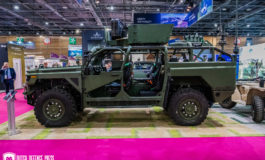
Krauss-Maffei Wegmann (KMW) has received an order from Bundesamt für Wehrtechnik und Beschaffung (BWB) (Federal Office for Defence Technology and Procurement) to deliver an innovative, highly protected vehicle. The vehicle designated "GRIZZLY" affords its crew optimum protection, especially against explosive devices, mines and direct fire. The innovative concept fully meets the schedule of requirements of the German Army, and the increasing needs of NATO and UN forces for peacekeeping missions worldwide as well.
The "GRIZZLY" is to be tested as part of the current procurement project of the German Army covering Class 4 protected command and role-specific vehicles in (highly protected vehicles) with a gross vehicle weight of 25 tons. It thus closes an existing gap in the German Army's vehicle programme between the DINGO 2 (12.5 tons) and the 33-ton BOXER. The first vehicle will be delivered as early as November 2007.

HIGH PAYLOAD AND FLEXIBILITY

The GRIZZLY offers space for 10 fully equipped soldiers. With its payload, it therefore exceeds by more than 50% the 3 tons required in the RFP. As against conventional vehicles, it also stands out for an innovative protection concept for the vehicle crew. Driver´s station and crew compartment form an integral safety cell which, in addition to ballistic threats, projectiles, missiles and mines, above all affords optimum protection against homemade explosive devices (Improvised Explosive Devices). Special stiffening elements developed by KMW protect the crew from injuries even in a rollover accident. Moreover, engine and transmission are ballistically protected.
A further plus is the flexibility of KMW´s vehicle concept. Its dimensions make the GRIZZLY air portable on A 400 M transport aircraft.

MODULAR SYSTEM PERMITS DIFFERENT VERSIONS AT REASONABLE COST

Following the successful completion of the trials, the GRIZZLY will be available in a large number of versions. In addition to the highly protected transport versions, they will also include ambulance and command post variants. The KMW-developed intelligent modular system, in addition to the 6x6 version to be delivered under the production contract, also permits the construction of a smaller 4x4 model as well as an 8x8 type of correspondingly higher payload.
The engine output of 331 kW accelerates the GRIZZLY up to 90 kph with a radius of action of more than 700 km. The vehicle thus sets new standards in the GFF 4 class.
"The GRIZZLY concept optimally meets the currently increased requirements established by land forces in terms of technical performance capability, mission flexibility and above all crew protection. We therefore see a good chance of receiving further orders from other countries", says Frank Haun, Chairman of the KMW Board.
More info at www.kmweg.de

***

ALLIES AGREE ON STRATEGIC AIRLIFT CAPABILITY INITIATIVE
20 June 2007


NATO Allies agreed today to set up a new NATO agency to acquire and manage C-17 strategic transport aircraft on behalf of a group of 15 NATO nations and two Partnership for Peace countries. Secretary General Jaap de Hoop Scheffer welcomed the decision. The Strategic Airlift Capability initiative will help address NATO’s -- and Europe’s -- critical shortfall in strategic airlift.  This capability will support our current operations, including in Afghanistan, and will be a pillar of the Alliance’s long-term transformation.
The Strategic Airlift Capability (SAC)  initiative was first announced in September 2006, and hailed at the November 2006 NATO Summit in Riga. Strategic airlift has been a long-standing critical shortfall for the NATO Alliance.  At the Riga summit, NATO Heads of State and Governments noted the need for “forces that are fully deployable, sustainable and interoperable and the means to deploy them.”   They also  endorsed several initiatives to increase strategic airlift, including the SAC, the Strategic Airlift Interim Solution (SALIS), and offers to coordinate support structures for A-400M strategic airlift, which 7 Allies are planning to acquire beginning in 2010.SAC aircraft will be flown by multinational aircrews; a multinational military structure will be created to command and control the aircraft. 
The 17 SAC nations will fly the planes based on their national requirements, which may include national, NATO, or EU operations, as well as other international purposes such as humanitarian airlift or disaster relief for the UN.  In today’s decision, the Alliance formally approved the establishment of a NATO Airlift Management Organization (NAMO) and NATO Airlift Management Agency (NAMA) to acquire and support the aircraft.  The SAC plans to acquire 3-4 C-17s; the first is expected to be delivered in mid-2008.
The SAC planes will be configured in a similar way as the C-17s flown by the US Air Force, Canadian Air Force and the UK Royal Air Force. The air crews will be trained to the same basic standards, including air-to-air refueling and night vision operations.
The following NATO nations are members of the Strategic Airlift Capability initiative: Bulgaria, Czech Republic, Denmark, Estonia, Hungary, Italy, Latvia, Lithuania, Netherlands, Norway, Poland,  Romania, Slovakia, Slovenia, United States, Sweden and Finland, both Partnership for Peace Countries, are also SAC Members.
Membership in the airlift fleet remains open to other nations.
More information at www.nato.int

***

Sweden contracts with Rheinmetall for BIRDIE 118 helicopter self-protection system
29 May 2007

Export breakthrough for new IR decoy
The Swedish Defence Materiel Administration has awarded Rheinmetall Waffe Munition GmbH an order for BIRDIE 118 aircraft decoys for Swedish Air Force helicopters. The decoys will be delivered in 2007 and used in future international operations.
BIRDIE, an acronym for “Bi-spectral InfraRed Decoy Improved Efficiency”, is a proprietary development of Rheinmetall Waffe Munition. The BIRDIE represents a new departure in protecting helicopters against modern infrared-guided surface-to-air and air-to-air missiles. It is also uniquely effective in countering shoulder-launched MANPADS, which are increasingly used by non-state actors, terrorist organizations, etc.
It can be used in any 1x1" NATO standard dispensing system for aircraft self-protection, and is also available in a 2x1" calibre version, the BIRDIE 218. Numerous NATO and national tests have proved the BIRDIE’s effectiveness against even the most advanced guided missiles with two-colour analysis.
More information at www.rheinmetall-defence.com class="style1" style="line-height:14.0pt;">*** class="style1" style="line-height:14.0pt;">BELGIUM APPROVES ACQUISITION OF 10 NH90 HELICOPTERS
27 April 2007

The Belgian government has decided today, during a Council of Ministers, to procure 10 NH90 helicopters, consisting of 8 firm orders (4 TTH and 4 NFH) plus 2 optional aircraft.
This is the confirmation of the strong interest shown by Belgium towards the NH90 since the very early stages of the Programme, when Belgium was involved with the first design studies launch by NATO.
Belgium is now the 14th country ordering the NH90 and the 2nd country, after Portugal in 2001, to join the international programme organisation, NAHEMO, which was initially formed in order to gather the National Armament Directors of the 4 countries which have instigated the NH90 Programme; i.e. France, Germany, Italy and The Netherlands joined by Portugal in 2001.
The Belgian industry will benefit from to the procurement of NH90 helicopters through an extensive industrial cooperation programme.
With 4 NFH and 4 TTH, the NH90 helicopters will provide the Belgian Armed Forces with comprehensive Search and Rescue, Naval and Tactical Transport capabilities.
The NH90 is a new generation military helicopter equipped with modern technology and systems able to perform any kind of mission by day or night and in adverse weather conditions. The NH90 features a corrosion-free carbon fibre fuselage, fly-by-wire controls, composite rotors and many other leading edge technologies.
NHIndustries is also pleased to announce that the NH90 will be presented to the Belgian public (Static Display only – Live instrument panel) on the occasion of the next national aeronautical event “Helidays” in Bierset from 12th to 13th May 2007.
The twin-engine, medium-size NH90 helicopter is provided by the consortium NHIndustries, the Company owned by AgustaWestland (32%), Eurocopter (62.5%), and Stork Fokker (5.5%).
The NH90 helicopter programme is the largest ever launched in Europe, with firm orders now reaching 453 units plus 102 options to equip and modernize the Armed Forces of France, Germany, Italy, The Netherlands, Portugal, Finland, Norway, Sweden, Greece, Oman, Australia, New-Zealand, Spain and Belgium. Final negotiation steps are in progress with several other Defence Forces to secure contracts concerning 76 additional NH90, both in the Tactical Transport and Naval versions.
More info at www.nhindustries.com

***

Rheinmetall air defence system to protect Bundeswehr forward operating bases from attack
03 April 2007

The German government has selected the Rheinmetall Group of Düsseldorf to develop a system for protecting Bundeswehr forward operating bases. Known by its German initials NBS, this new short-range force protection system will detect and physically intercept incoming rocket, artillery and mortar (RAM) rounds.
Signed on 30 March 2007 at the Federal Agency for Defence Technology and Procurement (BWB) in Koblenz, the development contract is worth €48 million. The NBS system is intended to give the Bundeswehr a reliable counter-RAM (or C-RAM) capability within two years, employing new state-of-the-art air defence technology to protect stationary military assets. The first fully functional NBS unit will be ready for deployment as soon as development work is completed in the third quarter of 2009. Should the German government opt to buy the NBS, it will be used to protect Bundeswehr forward operating bases in places like Afghanistan.
Thanks to its Skyshield system, Rheinmetall is a global leader in short and very short-range air defence. The prime focus of the NBS development contract will be to modify and improve Skyshield 35mm guns, sensors, fire control technology and Ahead ammunition to deal with asymmetric threats in out-of-area theatres of operation.
Because the NBS represents an important new dimension in the Bundeswehr’s future air defence system (SysFla), the order is another major strategic success for Rheinmetall AG’s air defence division.
More information at www.rheinmetall-defence.com

***

FIRST AUSTRALIAN NH90 OF 46 ORDERED TAKING TO THE AIR
28 March 2007

The first Australian NH90 – Tactical Transport Helicopter version (TTH) wearing the Customer designation TAUA01 took off from Marignane (France), the Eurocopter’s facility.
This flight lasted 1 hour and 35 minutes away from the airfield and fulfilled all expectations.
Australian partners working locally for many months at Eurocopter’s Marignane, within Integrated Teams were proud to attend this major event on behalf of their country, measuring deeply by themselves the nature and complexity of the technological and human processes commonly achieved since the very beginning of their presence in France.
The MRH90 (Dedicated designation for Australian NH90) is an extremely capable helicopter as any other NH90 variant. It features a damage tolerant design, a large cabin volume with two wide sliding cargo doors and a rear ramp, altogether providing operational users with enhanced sea operation capabilities strongly reinforced thanks to a full-composite, hence corrosion-free, airframe. Part of a comprehensive modernization and rationalization of the Australian military helicopter fleet, the 46 already contracted MRH90 will provide Australia Defence Force with true opportunities for joint fleet management.
Incidentally, the same day, in Halli (Finland) has flown the 3rd NH90 High Cabin Version of the Swedish Customer. With 1st and 2nd Swedish NH90 built in Marignane, BSWA03 is the 1st of the 16 remaining ordered NH90 to be assembled and flown in this Patria facility.
It is noticeable that both flights duration of 1 hour and a half demonstrate the highest reliability standards of the NH90 helicopter family and Industry capacity to achieve a sustained and regular ramping up pace.
More info at www.nhindustries.com

***

Swiss Army orders new Armoured Engineer Vehicle from Rheinmetall
9 January 2007

All Leopard 2 user nations are potential customers

Rheinmetall AG of Düsseldorf has won an order from the Swiss Army for a new generation of armoured engineer vehicles, an important reference customer. Under the order, Rheinmetall will supply the Swiss Army with twelve Kodiak armoured engineer vehicles, known in Swiss military parlance as the “Geniepanzer”.
Based on well proven components from the Leopard 2 main battle tank, the Kodiak has clear market potential in all Leopard 2 user countries. A number of nations have already expressed an interest in this state-of-the-art system; some have launched procurement projects already.
Apart from its role as a heavy-duty combat engineer tool – whether in military scenarios or disaster relief operations – the Kodiak can be used to breach lanes through minefields, crucial for assuring the mobility and safety of friendly forces.
Joining forces, Rheinmetall subsidiary Rheinmetall Landsysteme GmbH of Kiel and RUAG Land Systems of Thun, Switzerland have set up a consortium to develop, market and manufacture the Kodiak. The Swiss Army is scheduled to start taking delivery of the new systems in 2009.
Over the years, some 8,000 tracked and wheeled vehicles have left the Rheinmetall Landsysteme assembly line, making the company one of the world’s most experienced makers of tracked and wheeled armoured vehicles as well as combat support systems and NBC detection technology.
To perform its primary mission, the Kodiak is equipped with a high-performance hinged arm excavator mounted in centre position, as well as a dozer system with innovative cutting and tilt angle settings and a double-winch system consisting of two 9t capstan winches. When
combined and deployed in multiple traction mode, these provide a pulling force of up to 62 tons. Thanks to a quick-release coupling, the excavator bucket can be exchanged for a number of other devices, including a hydraulic hammer and a universal-gripper. All of these tools are electro-hydraulically controlled and can be operated by the driver with two joysticks.
Rounding out the system's operational capabilities, the dozer blade can be swapped for a full-width mine plough, turning the Kodiak – when additionally equipped with a signature-duplicator and a lane-marking unit – into a high performance minefield-breaching system. The Kodiak’s anti-landmine protection technology features correspond to those of the latest generation of Leopard 2 MBT.
To defend itself, the Kodiak will be armed with a 12.7mm machine gun and smoke grenade launcher.
More information at www.rheinmetall-defence.com


****

Rheinmetall to supply Bundeswehr with Wiesel 2 armoured field ambulances
15 December 2006

Germany’s Federal Agency for Defence Technology and Procurement (BWB) in Koblenz has contracted with Rheinmetall to supply the Bundeswehr with a second lot of Wiesel 2 tracked armoured vehicles configured as field ambulances. In a separate order, Rheinmetall will also be supplying the Bundeswehr with two Wiesel 2 training vehicles and two training models as well as accompanying logistical materiel for training German maintenance units. Together the two orders are worth around €9 million.
Under the terms of the orders, delivery of the vehicles and training equipment is to be largely completed by the end of 2007. These orders ensure stable utilization of the company’s Wiesel 2 production capacity in Unterlüß and Kiel during the coming year.
This brings the number of Wiesel 2 vehicles procured by the Bundeswehr to over 140. It also consolidates Rheinmetall’s role as the Bundeswehr’s leading supplier of lightweight tactical vehicles for out-of-area operations.
More information at www.rheinmetall-defence.com

****

EADS and its partners are chosen to supply Netherlands’ integrated air
defence system

Amsterdam/Ulm, 6 December 2006

- Full Operational Capability for Netherlands Future Ground Based Air Defence
- Kongsberg and Oerlikon Contraves as partners
- Interoperability with NATO partners assured

Today the Dutch Ministry of Defence awarded EADS the contract to supply technical systems for battle management command, control, communication, computers & information (BMC4I) part of the Netherlands Future Ground Based Air Defence (FGBAD NL). In the face of tough competition, EADS and its partners – Oerlikon Contraves and Kongsberg – won the contract with currently one of the world's most modern mobile air reconnaissance and weapon coordination system solutions available.

Through this contract, Full Operational Capability (FOC) of FGBAD NL will be realised. The contract covers full echnical system integration responsibility from sensor-to-effector as well as full maintenance responsibility. The components of the system are two TRML-3D mobile surveillance radars from EADS, mobile command and control operation centres provided by EADS and Oerlikon, a digital radio communication network from Oerlikon and six Norwegian Advanced Surface-to-Air-Missile Systems II supplied by Kongsberg.

The Initial Operational Capability (IOC) contract - awarded in October 2004 – covered three TRML-3D mobile surveillance radars, mobile command and control operation shelters including a radio-based communications system – all of which were successfully delivered.
“This project testifies to the competence of EADS when it comes to air defence solutions. We are proud to contribute towards achieving an integrated, networked air defence system for the Netherlands,” Hervé Guillou, CEO of EADS Defence and Communications Systems, pointed out. “For the Dutch Ministry of Defence, the FGBAD programme is an important step in the modernization of air surveillance by ground-based air defence systems,” stated the Dutch State Secretary for Defence, Cees Van der Knaap.

FGBAD NL supplements and completes the air surveillance command and control network and ensures the interoperability and compatibility of the air defence systems used by the armed forces in the Netherlands with those of their NATO partners. The system will also be used by crisis response forces at home and abroad.
To ensure weapon coordination, all components of the FGBAD NL are networked in a wireless LAN communications infrastructure. This modern communications network enables the secure, real-time exchange of information between the radar units and the command vehicle and weapon systems so that the present air situation and the threat level can be continuously analyzed. With this analysis, depending on the set priorities, aerial objects such as helicopters, cruise missiles and unmanned aerial vehicles can be assigned by the air defence systems as targets.
www.eads.com

****

Oakley Agrees to Acquire Eye Safety Systems, Inc.
Nov 22, 2006

Oakley, Inc. (NYSE:OO) today announced it has signed a definitive agreement to acquire essentially all the assets of Eye Safety Systems, Inc. (ESS), one of the world’s largest suppliers of military, law enforcement and firefighting protective eyewear.

“This acquisition represents another major step for Oakley in our strategy to accelerate growth in our core optics business,” said Scott Olivet, chief executive officer, Oakley, Inc.  “ESS’ brand and company reputation, strong  goggle business, and breadth of distribution in military, firefighting and law enforcement channels complement our existing military eyewear platform.”  

“Oakley is at its best when we work to solve the most difficult problems of the world’s most demanding users; the exact same thing can be said of ESS,” continued Olivet.  “By joining forces with ESS, we are combining two individually strong brands with remarkably similar core values, enhancing both of our abilities to provide the best product and highest quality service possible.” 

“This represents an exceptional and timely opportunity for both ESS and Oakley,”  said John Dondero, founder and president, Eye Safety Systems, Inc.  “We believe that Oakley’s optics expertise, financial resources and international infrastructure will allow ESS to significantly expand its presence in the global protective eyewear markets.  Our management team is enthusiastic about this transaction and believes this combination is an excellent step forward for our customers, employees, and most importantly the military, law enforcement, and firefighting professionals who rely daily on our eye protection equipment in their challenging work environments.”

“We are extremely proud of our military heritage and excited to combine a shared commitment to product research and development, advanced technology and excellent support for this important channel,” said Erick Poston, military business unit manager, Oakley, Inc.  “ESS enables us to create a much broader product and distribution platform capable of enhancing service to our existing customers and creating potential for future growth.”

The acquisition is subject to certain indemnities, post-close adjustments and customary closing conditions.  The companies expect the acquisition to be closed during the first half of 2007.   ESS will continue to operate in Sun Valley, and Dondero will continue to lead the development and expansion of the business as its president.
More information at www.essgoggles.com and www.oakley.com

****

NEW WHEELED APC FOR DUTCH ARMY
Oct 14, 2006

The Dutch cabinet has agreed to the purchase of 200 Boxer apc's for the Dutch army. Undersecretary for Procurement Van der Knaap made the proposal after several years of development and study. The Boxer is a joint German/Dutch development that is plaqued with setbacks and rising costs. The order is worth 624 million Euro.

The Boxer will replace the aging M-577 and part of the YPR-765 tracked apc fleet, in use since the 1970's. It will perform battle-support tasks like medical evacuation, forward supply, engineer tasks and command.

Pending parliamentary approval in both Germany and the Netherlands the Boxer will be build in both countries. Krauss-Maffei Wegmann (KMW) and Rheinmetall Landsysteme (RLS) of Germany will cooperate with Stork, who is 'lead industry' for the Netherlands.

The first Boxers are expected to be in service in 2011.

(photo: prototype Boxer and Twister remote weapons station from Thales Nederland during live-fire trials/DDP)

****

ESS Introduces ICE NARO™ Eyeshield
Aug 17, 2006

ESS ICE NARO Smaller-Fit Ballistic Spectacles Introduced


ESS Eyewear has introduced the ICE NARO™, a new smaller version of the company’s popular ICE 2.4™ ballistic spectacles.  The new product is approximately one half inch narrower between the temples, with lenses that look at home on smaller male and female faces, but also offer greater proportional coverage and full compliance with the US military specification MIL PRF 31013 and ANSI Z87.1+ standards.

ESS vice president Brian Ross commented: “In listening to our customers, we identified an unmet need for ballistic spectacles that fit near 25% of the Service Members, first responders, and peace officers with smaller, narrower faces.  The ICE NARO will allow them to operate in comfort without sacrificing safety.”   

The ICE NARO™ design incorporates a new temple style that is rolling out as an upgrade to the entire ICESpectacle Series.  The new temples have a narrower cross section for better comfort and integration with helmets, helmet straps, and communications equipment.  The new temples offer a wider range of fit adjustment and easier bend-to-fit properties than the original ICE™ temples, and they are easier to install and detach for rapid lens swapping.

There are two basic varieties of the new product offered: the ICE NARO™ which includes clear, smoke gray and hi-def yellow lenses, and the ICE-2 NARO™ two-lens model with clear and smoke gray lenses.  Both NARO™ kits come with a case, elastic strap, and an anti-fog cloth.  All ESS ICE™ and ICE NARO™ spectacles can be fitted with the same prescription lens carriers in ESS’ Rx product line.  These same carriers also fit in either the ESS Profile™ or Advancer™ series goggles.
More information on www.essgoggles.com

****


Valid CSS!

Valid XHTML 1.0 Transitional

[Valid RSS]

About Us | Disclaimer | Copyright | Contact Us | ©2003/2007 Dutch Defence Press